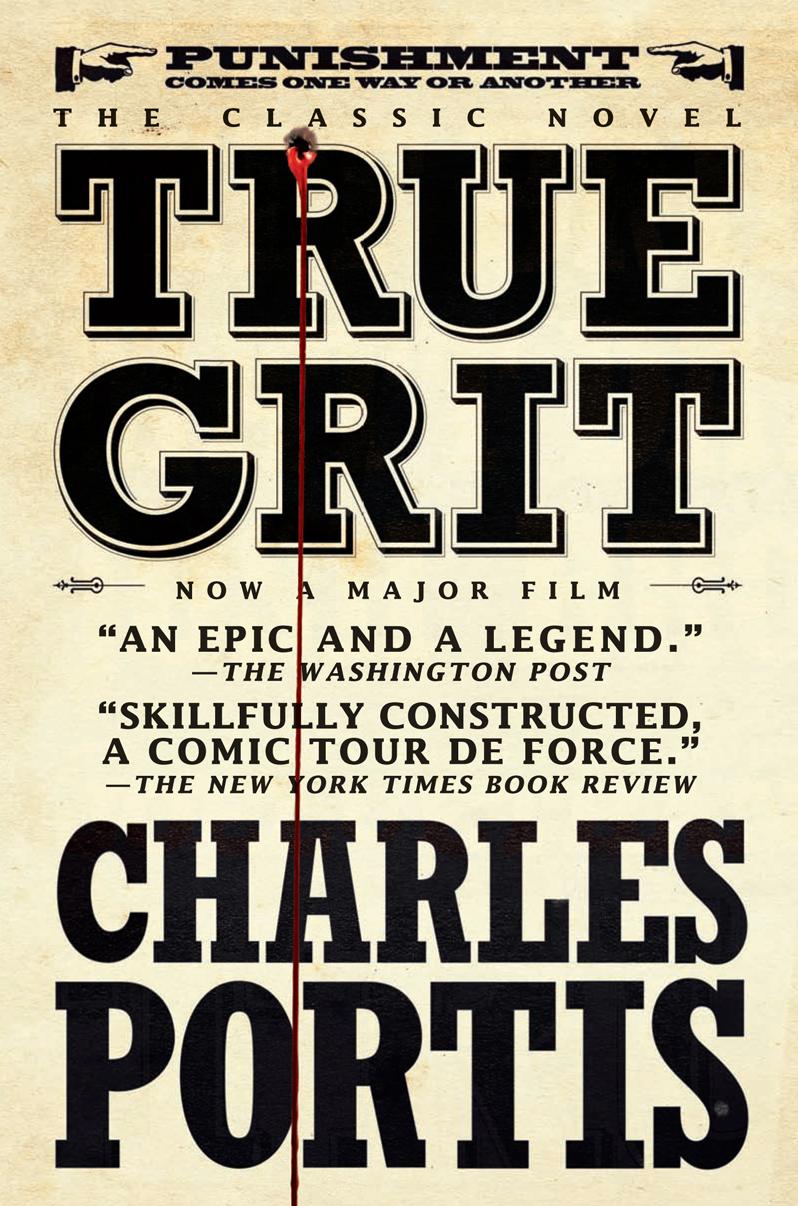
True Grit is one of the great American classics—a
sensational, dryly comic coming-of-age tale set after the Civil War. Appealing to adults and teens alike since its
first publication in 1968 to it’s double
adaptation for the big
screen, and its chart-topping stint on the New
York Times bestseller list, Charles Portis’s masterpiece is a model in
enduring literature. Wednesday, December 05, 2012
TRUE GRIT, YA and Young Heroines in Literature
True Grit is one of the great American classics—a
sensational, dryly comic coming-of-age tale set after the Civil War. Appealing to adults and teens alike since its
first publication in 1968 to it’s double
adaptation for the big
screen, and its chart-topping stint on the New
York Times bestseller list, Charles Portis’s masterpiece is a model in
enduring literature. Thursday, December 08, 2011
On the first day of Christmas, Overlook Press gave to me…
Beginning today, and continuing every weekday through Friday, December 23rd, come check out the Winged Elephant, where you’ll have a chance to win free copies of classics from our backlist as well as early sneak peeks for 2012. We’ll be giving away signed copies, author collections, limited edition volumes, and genre themed book sets by our favorite Overlook authors. Neither the contest nor the books are Christmas exclusives—we just can’t resist using the song!
Today we are spreading the holiday cheer by giving away a complete set of Charles Portis paperbacks, including True Grit, Norwood, Masters of Atlantis, Gringos, and The Dog of the South. Many readers may know Portis for True Grit, the 1968 novel that was readapted for film last year by Joel and Ethan Coen, but his four other novels are all classics in their own right— cool, sympathetic, funny, and undeniably Portis. Conan O’Brien called Masters of Atlantis “one of the few laugh-out-loud novels I’ve read,” and Entertainment Weekly described Norwood as a “glimpse of how a 20th-century Mark Twain might write.” Perfect for both the diehard Portis lover and the uninitiated novice, these books will provide hours of comic entertainment to one lucky recipient.
You can enter to win books in three different ways:
1. Comment on this post
2. Tweet at us using the hashtag #OverlookChristmas
3. Leave a comment on our Facebook page
You can enter once in each area until 8 am tomorrow morning, and we will be announcing a winner in tomorrow’s post.
Be sure to come back tomorrow for even more holiday gifting and to check to see if you’ve won. Happy holidays to everyone from the Overlook Press!
Tuesday, June 07, 2011
Free set of Charles Portis books!
The three sets will be given to commentators on this blog, on facebook and on twitter.

True Grit has been back in the news recently, mentioned in the Wall Street Journal and the Southern Literary Review. As SLR notes, Portis' works are also an excellent idea for a Father's Day gift for a dad who loves to read.
To whet your appetite, here's a taste of each novel:
True Grit, Portis's famous novel was first published in 1968 and became the basis for two films, the 1969 classic starting John Wayne and 2010's new version starring Academy Award winner Jeff Bridges and Matt Damon. True Grit tells the story of fourteen year old Mattie Ross as she leaves home to avenge her father's death. With one-eyed Rooster Cogburn, the meanest available U.S. Marshall at her side, Mattie pursues the killer into Indian Territory.
Norwood, the first novel by the long-acclaimed author establishes his unique wit and cool yet funny style. Out of the Neon Desert of RollarDromes comes ex-marine and troubadour Pratt sent on a mission to New York. By the time he returns home to Ralph, Texas, Norwood has met his true love, Rita Lee, on a Trailway bus; befriended Edmund B. Ratner, the second shortest midget in show business; and helped Joann, “the chicken with a college education,” realize her true potential in life.
The Dog of the South is the story of Ray Midge as he tracks his wife Norma--who has run off with her first husband-- by following credit card receipts (his credit card!). As Midge chases Norma from Arkansas down to Mexico, and into Honduras, Portis spins an extraordinary novel of deep longing paired with comic eloquence.
Masters of Atlantis is a novel stationed in France in 1917 centering Lamar Jimmerson, leader of the modern-day Gnomon Society, who comes across a little book crammed with Atlantean puzzles, Egyptian riddles, and extended alchemical metaphors, the Codex Pappus said to be the sacred Gnomonic text. Portis opens up a world of misfits, con men, and innocents.
Gringos is about the life of Jimmy Burns, an expatriate living in Mexico and unearthing pre-Columbian artifacts. Jimmy's laid back life is threatened when a ninety-pound stalker named Louise suddenly appears, along with a wave of hippies led by a murderous ex-con guru, archaeologists illegally unearthing the Mayan tombs and Louise's husband's quest for UFO landing sites. Charles Portis' talent and astute eye for the absurd detail has made him one of America's foremost writers.
Charles Portis was the London Bureau chief of the New York Herald-Tribune, and was a writer for The New Yorker. All of his novels have been published by Overlook Press.
Comment, Facebook or Tweet now for your chance to win!
Tuesday, February 08, 2011
Did you miss Peter Mayer on Leonard Lopate (WNYC)?
Listen below or go here to listen to the talk and read a bit of background.
Tuesday, January 25, 2011
Congratulations, True Grit film!
Jeff Bridges - Actor in a Leading Role
Hailee Steinfeld - Actress in a Supporting Role
Art Direction
Cinematography
Costume Design
Directing
Best Picture
Sound Editing
Sound Mixing
Adapted Screenplay
As an added bonus, the ebook of True Grit is available today across all ebook platforms, as are Charles Portis' other four novels. Happy reading, and happy film viewing! Good luck to everyone at the Oscars!
Thursday, January 20, 2011
Hooray for TRUE GRIT and Charles Portis!

Yesterday, we got the extremely exciting news that True Grit will be the next #1 on the New York Times bestseller for trade paperback fiction. For a book that's been around since 1968, the "Portis revival" (The New Yorker) is incredibly welcome. While of course we love to see our books sell, we acquired Charles Portis' work long before the Coen Brothers film adaptation was planned--because we think they are truly American classics that deserved to stay in print.
To celebrate, we're giving away a FULL SET of Charles Portis' novels. At this point, everyone's heard of True Grit. But some of us are huge fans of Norwood here, and many consider The Dog of the South to be Portis' finest work. We also thought Gringos and Masters of Atlantis were absolute American classics. So we're giving away ALL FIVE books to one lucky winner. Leave a comment here, on Twitter or on Facebook to win--winners announced tomorrow!
Don't forget that these will all be available as ebooks next week and stay tuned for the announcement of the Academy Awards nominees on January 25--we're keeping our fingers crossed that the great reviews of the film translate into much-deserved Oscar nods! And check out this great book buzz from USA Today about True Grit.
Happy reading!
Tuesday, December 28, 2010
Happy birthday, Charles Portis!

A very happy birthday to Charles Portis, one of our most beloved authors. Hope you all got copies of True Grit--or even better, other Portis novels like the delightful The Dog of the South--in your holiday stockings this year!
Anyone see the new Coen Brothers film yet? We'd love to hear your comparisons of the book to the movie...
And a reminder for anyone who got a brand-new ereader this holiday season--TRUE GRIT will be released across all ebook platforms on January 14.
Happy reading, and if you're one of our East Coast readers, hope you got to stay home curled up with a good book and a warm drink today! Snowcapalypse now?
Monday, December 20, 2010
More Grit for Charles Portis
Chip McGrath profiles our man in Little Rock for The New York Times today:"The arrival of the Coen brothers’ movie “True Grit” on Wednesday is likely to bring Charles Portis a new surge of attention he has no use for. Mr. Portis, the author of the 1968 novel on which the new film is based (as was the 1969 John Wayne version) is allergic to fame.
He’s not a Pynchonesque recluse, exactly. He is occasionally spotted in Little Rock, Ark., where he has lived for 50-odd years; he even went to a gala sponsored there recently by the Oxford American, a literary magazine, and consented to receive a lifetime achievement award, though he sat in the 14th row, or as far from the stage as he could. But Mr. Portis doesn’t use e-mail, has an unlisted phone number, declines interview requests, including one for this article, and shuns photographs with the ardor of a fugitive in the witness protection program. He hasn’t published a novel in nearly 20 years.
The writer and filmmaker Nora Ephron, who got to know Mr. Portis in the early ’60s, when he was a reporter for The New York Herald Tribune, recalled that back then he was more sociable. “Charlie was just charming, the life of the party almost,” she said. “But he was a newspaper reporter who didn’t have a phone. The Trib had to make him get one. So even back then the pattern was there.”
His elusiveness has only enhanced his status as a cult writer’s cult writer, cherished by a small but devoted following. He has published four novels besides “True Grit” (all five have recently been reissued in paperback by the Overlook Press), and for years those in the sect have been pressing them on new readers like Masons teaching the secret handshake. The journalist Ron Rosenbaum, the unofficial grand vizier and first hierophant of Portis admirers, has called him “perhaps the most original, indescribable sui generis talent overlooked by literary culture in America.”
“True Grit,” Mr. Portis’s second novel, which was serialized by The Saturday Evening Post and appeared on the New York Times best-seller list for 22 weeks, is actually a divisive matter among Portis admirers. There are some, like the novelist Donna Tartt, who consider it his masterpiece, a work comparable to “Huckleberry Finn.” Others, like Mr. Rosenbaum, resent “True Grit” a little for detracting attention from Mr. Portis’s lesser-known but arguably funnier books: “Norwood” (1966), “The Dog of the South” (1979), “Masters of Atlantis” (1985) and “Gringos” (1991). The writer Roy Blount Jr., an old friend of Mr. Portis’s, suggested recently that Mr. Portis himself was a little embarrassed by the success of “True Grit.”
“I think that’s why in his next book, ‘Dog of the South,’ he set himself the challenge of a funny book written by a boring narrator,” Mr. Blount said. “That’s why other writers love him so much.”
“True Grit,” the story of the 14-year-old Mattie Ross, from Yell County, Ark., who with the help of the one-eyed marshal Rooster Cogburn sets out to avenge the murder of her father by a drunken hired man named Tom Chaney, is not unfunny. It’s simultaneously a thoroughly satisfying western and a parody of one. But unlike Mr. Portis’s other books “True Grit” is a period piece — the story takes place in 1873 but is recounted decades later, when Mattie is by her own description a cranky old spinster — and the narrative voice is a feat of historical ventriloquism.
Mattie’s prose is stiff, formal (a quality lovingly captured by the Coen brothers), a little pious and platitudinous, given to scriptural quotation and fussy quotation marks: “I will go further and say all cats are wicked, though often useful. Who has not seen Satan in their sly faces? Some preachers will say, well, that is superstitious ‘claptrap.’ My answer is this: Preacher, go to your Bible and read Luke 8: 26-33.”
Mattie is lovable in her way, and though grit is what she admires in Rooster, she is hardly lacking in that department herself. But she is also humorless, righteous and utterly without either self-doubt or self-consciousness. She has no idea how she or her words come across on the page, nor would she care if she did.
“The Dog of the South” and “Gringos” are also written in the first person, and the two others might as well be. The voice in all them is loose and informal, even a little digressive, with a noticeable Southern quality. Mr. Portis’s friends say he talks much the same way, and to judge from “Combinations of Jacksons,” a memoir he published in The Atlantic in 1999, his nonfictional style isn’t much different from his fictional one: in both he is a great noticer, always alert to the odd but telling detail.
What the other novels have in common with “True Grit” is their deadpan quality. Most comic novels — think of anything by P. G. Wodehouse, say, or Ring Lardner — are fairly transparent: they unabashedly try to be funny and let the reader in on the joke. The trick of Mr. Portis’s books, especially the ones told in the first person, is that they pretend to be serious. They’re full of odd events and odd people with names like Norwood Pratt, Raymond Midge and Dr. Reo Symes, inventor of the underappreciated Brewster Method, a miracle cure for arthritis. But these are presented without a wink or a nudge, or any sense that slapstick touches like smooth-talking midgets, bread-fondling deliverymen or elderly gents wearing conical goatskin caps are at all unusual.
Mr. Portis evokes an eccentric, absurd world with a completely straight face. As a result there are not a lot of laugh-out-loud moments or explosive set pieces here. Instead of shooting off fireworks the books shimmer with a continuous comic glow.
Unlike the tightly plotted “True Grit,” the other books are all shaggy-dog stories of a sort. In “Norwood” (which was made into a 1970 movie starring Glen Campbell) Norwood Pratt travels all the way to New York from his home in Ralph, Tex., to collect a $70 debt and winds up engaged to a girl he meets on a Trailways bus. In “The Dog of the South” Ray Midge drives to Mexico from Little Rock in search of his wife, who has run off with her first husband and Ray’s Ford Torino. “Masters of Atlantis” is about two guys who create the Gnomon Society, an esoteric, Rosicrucian-like sect based on wisdom from the lost city of Atlantis. And in “Gringos” an American expat in Mexico falls in with some U.F.O. nuts and archeologists searching for a lost Mayan city.
But in one way or another the subtext of all these novels is the great Melvillean theme of the American weakness for secret conspiracies and arcane knowledge, and our embrace of con men, scam artists and flimflammers of every sort. In Mr. Portis’s pantheon of tricksters, moreover, writers rank pretty high. There’s John Selmer Dix, author of “With Wings as Eagles,” an inspirational manual for salesmen, whose admirers rank him higher than Shakespeare; the hack writer Dub Polton, author of “Hoosier Wizard,” a political biography that pretty much makes everything up; and Lamar Jimmerson, compiler of the Codex Pappus, the sacred Gnomon text, which deliberately includes a lot of obfuscation to “weary and disgust the reader” and put him off the track.
All these texts, you can’t help noticing, are in their way not unlike Mr. Portis’s books in the degree of devotion and enthusiasm they evoke in their readers. They’re not self-parodies but, rather, warnings about the dubiousness of reputation and about the dangers of taking the cult of authorship too seriously.
“Talking about himself is something that would feel false and strange to him,” William Whitworth, the former editor of The Atlantic and his old friend, said of Mr. Portis. “It would be like asking him to stand up and sing like Frank Sinatra, or be on ‘Dancing with the Stars.’ ”
Thursday, December 09, 2010
We depart from our regularly scheduled holiday giveaways
...to bring you this fantastic piece about TRUE GRIT by Malcolm Jones in Newsweek. Much like how dessert is our favorite part of any meal, the concluding paragraph is our favorite part of this column:True Grit is one of the great American novels, with two of the greatest characters in our literature and a story worthy of their greatness. It is not just a book you can read over and over. It’s a book you want to read over and over, and each time you’re surprised by how good it is. In every Portis novel, someone makes some kind of journey. His protagonists all have a little Don Quixote in them. They are at odds with the ordinary ways of making do, and they don’t care what the world thinks. In True Grit, these elements are the raw ingredients for one of the finer epic journeys in American literature. The Coen brothers, with their wry, dry-eyed take on all things American, are supremely equipped to bring Portis’s vision to the screen intact. But do yourself two favors: read the novel before you see the movie. You won’t regret it. As for the second favor: do not loan this book out. You’ll never see it again.
Go here to read the article on newsweek.com!
True Lit: Movies eclipse their literary sources all the time, which is fine when the book is ‘Jaws.’ But when John Wayne overshadows a master such as Charles Portis, we have a problem.
When Charles Portis published True Grit in 1968, the novel became a critically praised bestseller. Then a year later the movie, starring John Wayne, came out, and after that no one even remembered there was a book. If we know how 14-year-old Mattie Ross hired Rooster Cogburn, a one-eyed U.S. marshal with a drinking problem, to hunt down the man who robbed and killed her father, it’s mostly because the movie never stops showing up on television. As a result, most of the pre-release chatter about the new Coen brothers version of True Grit, with Jeff Bridges as Rooster, continually calls it a remake of the John Wayne film. For Portis fans this is nothing short of a crime.
Criminal or not, there’s nothing unique going on here. Any time Hollywood takes a book and turns it into a successful movie, there’s every chance that the book, however good it may be, will be forgotten. For every To Kill a Mockingbird or Gone With the Wind, where the book and the movie are equally respected and neither trumps the other, there are five examples of movies that eclipse the books they came from. Of all the people who have seen Alfred Hitchcock’s The Birds, how many have read the Daphne du Maurier novella on which the movie is based, much less recognize that in many ways the original is better? How many fans of Die Hard know it’s based on a good crime novel? Or Out of the Past, Vertigo, or Don’t Look Now (du Maurier again, this time a short story)? The explanation isn’t complicated: more people will go to see a movie on any given Wednesday afternoon than will read the book on which it’s based in a year. Almost always, the more successful the movie, the more forgotten the book. But understanding that situation is small consolation for authors or their admirers.
Readers who love Portis have it especially tough. To the extent that he’s known at all to the reading public, it’s as the author of True Grit—his one shot at the big time, and it backfires. This has only goaded his small but devoted band of readers to spread their gospel, and with good reason. His five novels are not hard to read or hard to find—it is a true credit to the publishing industry that someone, as a labor of love, is always republishing him. Maybe Roy Blount Jr. got closest to the truth of the matter when he said, “Charles Portis could be Cormac McCarthy if he wanted to, but he’d rather be funny.”
Readers and critics don’t like putting “funny” and “important” in the same sentence when talking about a writer, as though there’s something vaguely disreputable about someone who can make you laugh. Or, to put it another way, they are not comfortable with the idea that someone who can make you laugh can also make you think. Would Mark Twain still enjoy his status as a great American writer if he had not inserted the issues of slavery and racism into The Adventures of Huckleberry Finn? Just asking.
In the case of True Grit, the onus of humor is not even much of a problem. Which is to say, it’s not a comic novel but a novel that has comedy in it, and the funny stuff comes from the characters and the way they talk. Mattie Ross is an old woman when she sets down her adventures as a teenager in Arkansas and the Oklahoma territory, and there are numerous passages in her fusty, opinionated style that can make you smile and a handful that will have you laughing out loud. Writing about the ponies that her father had purchased right before he was killed, she admits that “it was wrong to charge blame to these pretty beasts who knew neither good nor evil but only innocence. I say that of these ponies. I have known some horses and a good many more pigs who I believe harbored evil intent in their hearts. I will go further and say all cats are wicked, though often useful. Who has not seen Satan in their sly faces?” If it were nothing else, True Grit would stand as an astonishing act of literary ventriloquism. From beginning to end, you never once doubt that this story is being told by a smart old spinster in the early part of the last century.
The novel outshines the 1969 movie at almost every turn. We remember that version because of John Wayne. Say what you like about his acting, it was the rare actor who could hold his or her own against Wayne onscreen. Poor Kim Darby as Mattie never had a chance. But the book is better balanced. Rooster may not think so at the outset, but Mattie always knows—and so do we—that she is every bit his equal. The admiration that grows between these two over the course of the story is genuine and affecting. And the devotion they feel for each other—demonstrated in actions, never words—is the most moving thing about this story. He saves her life; she pays to put a headstone on his grave. The Coen brothers’ version is a much better movie. They capture the raw surreality of the Arkansas frontier, and the acting is more of an ensemble work. Artists in their own right, they have been respectful but not slavish to Portis’s vision. But is this movie better than the book? That would be a very tall order.
Why quibble? True Grit is one of the great American novels, with two of the greatest characters in our literature and a story worthy of their greatness. It is not just a book you can read over and over. It’s a book you want to read over and over, and each time you’re surprised by how good it is. In every Portis novel, someone makes some kind of journey. His protagonists all have a little Don Quixote in them. They are at odds with the ordinary ways of making do, and they don’t care what the world thinks. In True Grit, these elements are the raw ingredients for one of the finer epic journeys in American literature. The Coen brothers, with their wry, dry-eyed take on all things American, are supremely equipped to bring Portis’s vision to the screen intact. But do yourself two favors: read the novel before you see the movie. You won’t regret it. As for the second favor: do not loan this book out. You’ll never see it again.
Thursday, December 02, 2010
Guest post from publisher Peter Mayer: On Meeting Charles Portis

A special guest post from Overlook publisher Peter Mayer, on his trip to Arkansas to meet Charles Portis, author of TRUE GRIT (along with other wonderful novels Norwood, Masters of Atlantis, Gringos and Dog of the South). Portis won't be participating in the media coverage surrounding the upcoming release of the Coen Brothers' film adaptation of his 1968 novel True Grit, he's considered one of the great American writers and a fascinating person. Here's Peter's experience meeting the man himself.
Meeting Charles Portis was an unlikely dream that came true. I had never been to Arkansas before, much less Little Rock, but as I found myself having to be there for another reason a couple of years ago, I just took a shot at calling or writing my author, despite having heard from many that Charles Portis was “reclusive.” He certainly over many years had ignored our various blandishments to take part in one or another author promotions, personal appearances, even some not too far from Little Rock.

As it turned out, Portis was anything but reclusive, simply not interested in being part of the publishing machine in which authors, for better or worse – and sometimes of necessity – play a leading role. He wanted his peace and he wanted it in order to write.
When my plane touched down in Little Rock, I didn’t believe he’d be there to meet me, but there he was with an anything-but-a modern pickup, half-ton I think, and before I’d climbed into the cab, hooked up my seat buckle, he asked me whether I was up for a drink. Indeed I was, I even hoped that Arkansas state laws permitted a thirsty man to drink and smoke at the same time. This not being the case, we went to The Capital Hotel. I’m not sure if this was a regular watering hole of his; I wasn’t sure then and after two days in Little Rock I still didn’t know. He certainly knew the clientele, many of the better known Little Rock grandees and good old boys. I quickly came to see that Charlie Portis was, yes, very regional, but also something much more sophisticated, something certainly not apparent in his novels. There probably are good reasons why readers sometimes mistakenly connect him with regional writers but variant purposes like Mark Twain and Cormac McCarthy. The connections have often more to do with a sense of place than anything else.
Frankly, I found myself – a New Yorker and a sometimes Londoner – not quite at home in The Capital Hotel. Unlike many New York-based publishers, I’d had broad experience in Texas, Indiana and Oklahoma and suspected that there must be a more basic Little Rock than the Capital Hotel. I wondered if my author had taken me to a place he imagined I’d be comfortable in. Happily, that evening, perhaps guessing my drift, he took me to more basic Little Rock haunts where I ate the kind of food I’d been hoping to find, along with many glasses of iced tea.
The discovery that my author was neither a recluse nor someone easily defined by Little Rock emerged when we started to talk about New York editors, agents – in particular his agent Lynn Nesbit – publishing, newspapers and journalism in general, New York itself, and then London, where he had been for some years the London Bureau Chief of The New York Herald Tribune. He asked me quite markedly about various people it turned out we both knew, in particular about Nora Ephron, whose work and gifts in general had never been lost on him. In fact, he talked about everything, everything except what I was greatly interested in – what was he writing now and when I would get to see it. “Eventually,” he said. All I learned was that he was indeed writing, that he didn’t write quickly.
Then we went back to anything he could tell me about the state of Arkansas, his book covers, his pleasure that we had put all his books back into print. Incredibly they had all been out of print when Overlook started what turned out to be a kind of mission: to turn America on to this extraordinarily gifted writer who seemed to us not to be getting his due. But he never asked how his books were selling – increasingly well, in fact. He just said he was glad they were available for anyone who might want to read them. Even in England, he said, as he had received letters from British readers. He was interested in everything I could share with him, but in a very self-contained way. A very good guy, I thought, a straight arrow with a habit and mind for the foibles of mankind. Anyone who reads his books will find, I think, that below the surface of all the extraordinary and extremely humorous details and characters he creates, there’s a very straight American arrow pointing heavenwards.
Tuesday, November 16, 2010
Publishers Weekly: Overlook Sees Portis Boost from 'Grit'
Overlook Sees Portis Boost from 'Grit' By Rachel Deahl Nov 16, 2010
The Coen Brothers' forthcoming adaptation of Charles Portis's True Grit has brought the celebrated, if reclusive, author back into the headlines...and onto readers' bookshelves. Overlook, Portis's publisher, has seen strong sales on its tie-in edition of the book, which it published on November 4. The indie house went to press for 100,000 copies of the edition--it features, as the house's previous edition did, an afterward by Donna Tartt, with updated cover art that references the movie. A rep from Overlook predicted that a second printing of the tie-in will happen before Christmas.
The Coens' film, which is scheduled to open wide on December 22, has also ignited an interest in Portis's backlist. Overlook's Jack Lamplough said the press "rescued" Portis's backlist a few years ago. Portis is known, Lamplough said, as America's "greatest 'unknown' author," and now Overlook is seeing a sales spark in other Portis titles like The Dog of the South, Gringos, Masters of Atlantis, and Norwood.
While movie adaptations are expected to spark sales for their print source material, Lamplough thinks the Coens' adaptation is a unique example of how a movie can help a book. True Grit, Portis's best known novel, was in some ways overshadowed by the popular 1968 John Wayne film of the same name, a film which veered in tone and content from the book. According to Lamplough, though, the Coens' have stayed closer to Portis's book than the Wayne western, and they've been talking that fact up. "The Coen Brothers and [their] stars Jeff Bridges and Matt Damon have repeatedly said the new movie takes its inspiration from the Portis novel, and not the 1968 movie starring John Wayne," Lamplough said.
Overlook has also been doing its part to publicize the book. The house launched a True Grit Facebook page and Lamplough said the house is working with Paramount on a publicity campaign that pushes both the movie and the book. To that end, an interview with Overlook publisher Peter Mayer will be featured on the planned DVD edition of the film.
Thanks, PW!
Thursday, November 04, 2010
Matt Damon praises Charles Portis in Empire Magazine
"It's just a brilliant adaptation," enthuses Damon. "They change stuff to make a two-hour film out of it, but retain so much of the dialogue, and Charles Portis - who is still alive - has an ear for the way people talk. It's a really special script."
Check out Empire Magazine's exclusive interview with Matt Damon for more. And don't forget to become a fan of True Grit on Facebook to keep up with all of the latest news and buzz surrounding the film, set to release in December!
Tuesday, October 26, 2010
Sneak Peek: the new cover of TRUE GRIT

which hits stores on November 5! You've probably heard about the new movie based on the novel, opening December 25 from the Coen Brothers and starring Jeff Bridges.
Look for our new edition of this Charles Portis classic next week!
Monday, April 13, 2009
Roy Blount on Southern Humor and Charles Portis
Author and humorist Roy Blount writes about his favorite Southern novels in The Wall Street Journal - and includes Norwood by Charles Portis: "His many writerly enthusiasts periodically proclaim that Charles Portis, of Arkansas, is a great, grossly underappreciated comic novelist, and we are right. Some prefer The Dog of the South or Masters of Atlantis, and I would be the last to deny the merits of those . . . Oh Lord, I've been sitting here for half an hour trying to think of some way to evoke how purely, unforcedly funny Portis is without using pushy words like "hilarious" that he would die before using. Norwood is my first love among his novels, but I don't want to thrust it upon you; it can take care of itself. In fact, it probably isn't any better than those other two, or than True Grit, which was Portis's one big popular success. Norwood is the story of a Korean War vet traveling to New York to collect a debt. Along the way he meets the world's smallest perfect fat man and rescues a performing chicken named Joann.
Tuesday, March 24, 2009
TRUE GRIT Film Remake Next Up for the Coen Brothers
Joel and Ethan Coen are working on an adaptation of the classic western True Grit by Charles Portis for their next project. According to Variety, their adaptation of the 1969 picture will hew more closely to the Charles Portis book on which it is based. In the book, a 14-year-old girl, an aging US marshal, and another lawman track her father’s killer through Indian country. While the 1969 version focused on Wayne, the Coens’ version will highlight the girl’s point of view.
Tuesday, September 16, 2008
Charles Portis's THE DOG OF THE SOUTH in GQ Magazine
Check out this rave from Joshua Ferris in the September issue of GQ magazine for the great Charles Portis: "Forget the Apatow ascent. Forget the Stewart-Colbert juggernaut. Funny as they are the greatest testament to American laughter is a novel published in 1979, by Charles Portis, called The Dog of the South. . . . Portis's quirky improvised dialogue is why The Dog of the South is such a winning book. It's the funniest iteration of that particularly American specimen, the road novel, with a finicky and hapless version of Sal Paradise as hero and a cast of characters that is half Pynchon, half Bottle Rocket. As with all great novels - and great comedy - how things end up matters a whole lot less than the fun had in getting there."
Tuesday, August 12, 2008
Charles Portis's THE DOG OF THE SOUTH for Summer Reading
The Baltimore Sun's Kevin Cowherd offers a money-back guarantee for readers of The Dog of the South, by Charles Portis:"If you're looking for a great summer read and have vowed to take a break from the usual trash that ends up on your nightstand, have I got a book for you. It's a wonderful comic novel by the great Charles Portis called The Dog of the South, first published in 1979.
Oh, I know what you're thinking.You're thinking: Hey, Mr. Helpful, how about recommending a book we've actually heard of, or something that's been published in this century? Sure, go ahead, make your jokes. But this is a terrific book. I feel so strongly about it that I will personally refund the purchase price of the book, plus an additional 20 percent for your troubles, if you buy it and don't like it. (Note to editor: Run some kind of legal disclaimer here that gets me out of that. Thanks.)
The Dog of the South is about a man named Ray Midge who sets out to track his wife, Norma, who has run off with her first husband, a sleazeball named Guy Dupree. To make matters worse, Norma and Guy have also taken Ray's credit cards and his car, not to mention his good raincoat and shotgun. So Ray waits for the credit card receipts to come in and sets off on the trail of the two lovebirds, tracking them from Arkansas to Mexico to Belize. Along the way, he meets all sorts of characters, including Dr. Reo Symes, a cranky physician who lives in a school bus called "The Dog of the South" and who's obsessed with the mysterious John Selmer Dix, a deceased writer of inspirational books for salesmen.
OK, that might sound a little too off-the-wall for your tastes. But I'm telling you, this novel will draw you in with its themes of betrayal and revenge, its deadpan dialogue and its lineup of picaresque rogues looking for adventure in a world they don't quite understand. If you take this book to the beach and start reading it, you won't even take a break to go in the water. You'll just keep reading and reading, and finally you'll look up and it'll be dusk. The beach will be almost empty, except for a few dogs and maybe a guy surf-fishing and a couple of old guys in gym shorts and knee-high socks running those stupid metal detectors over the sand. Then you'll go home and get something to eat and start reading again. And you won't be able to stop reading until you pass out from exhaustion.
Portis, by the way, was a Marine infantryman in the Korean War and later a reporter for a number of newspapers, including the Memphis Commercial Appeal, the New York Herald Tribune and the Arkansas Gazette.Then he left that low-brow racket and went legit, writing fiction full time, and we're all the better for it. His best-known novel is True Grit, which came out in 1968. The book is a taut tale of a 14-year-old girl who recruits an aging, drunken U.S. marshal named Rooster Cogburn to hunt down her father's killer. The book was made into a movie starring John Wayne, who won an Academy Award for best actor. And if you think Wayne was a good actor in that film, you must have a drinking problem, too. But that's how good the story was and how good Portis was, too. Portis made a few bucks off True Grit, of course. But for my money, The Dog of the South is his best work, and they should have made a movie out of it, too.
Anyway, you'll love this book. Go buy it today. Remember my money-back guarantee."
Monday, February 11, 2008
TRUE GRIT Turns Forty
Jenny Shank takes a look at Charles Portis's classic novel True Grit in New West, the fine magazine and website that bills itself as the "Voice of the Rocky Mountains." Shank suggests that "the irresistible voice of Mattie Ross rings as clear today as it must have in 1968." Overlook has reissued True Grit in new paperback edition featuring in introduction by novelist Donna Tartt.
Friday, December 07, 2007
TRUE GRIT Featured on Salon.com
In a recent essay on Salon, Allen Barra celebrates the 40th anniversary of True Grit, the Charles Portis classic recently reissued by The Overlook Press: "True Grit shares this with Portis' other novels: His characters are relentlessly grim while his prose is relentlessly funny. As Roy Blount Jr. put it, "Portis could have been Cormac McCarthy if he wanted to, but he'd rather be funny." That humor is often grim and always subtle; Portis is light-years from being 'the quintessential Southern humorist' he is often reputed to be, because he isn't a quintessential anything except original. I will leave it to others to determine whether True Grit is Charles Portis' best or quintessential novel, but it is the best Portis novel to read first."
Tuesday, September 18, 2007
TRUE GRIT on New York Times' Papercuts
Great notice today of Overlook's triumphant reissue of Charles Portis' True Grit, with a foreward by Ms. Donna Tartt on Papercuts, Dwight Garner's New York Times Book Blog:
Last week, when I posted some samples of Eliot Fremont-Smith’s memorable reviews from the mid-1960s, there was one I forgot – his piece on Charles Portis’s 1968 masterpiece “True Grit.”
Fremont-Smith effortlessly nailed the book’s breathless comic tone: